


Most people make serious commitments to their life on January 1.
New year. New plan. New discipline.
Same outcome.
I used to do that too, plan long term, feel motivated for a while, then slowly drift as life changed. And life always changes. New responsibilities. Health issues. Work pressure. Family. Fatigue. Reality.
At some point, it became obvious: waiting for a perfect start date is just procrastination with better branding.
So I stopped waiting.
The Lie of Long Term Planning
The biggest problem with long term planning isn’t lack of ambition.
It’s the assumption that the future will stay stable.
People plan five years ahead as if:
Their energy will remain constant
Their priorities won’t shift
Life won’t interfere
That’s fantasy.
Instead, I capped my planning horizon to one year. Anything beyond that is direction, not a plan. The real work happens closer to the present.
Here’s how I operate now:
Vision: 1 year
Planning: Monthly
Execution: Daily
Feedback: Weekly
Recalibration: Monthly
Change isn’t treated as failure.
Change is expected and engineered.
From Goals to Systems (Life OS)
I stopped planning goals and started operating my life like a system.
This became my Life OS.
The core shift was simple but uncomfortable:
I moved from task based planning to time based execution.
Tasks lie. Time doesn’t.
Tasks depend on motivation.
Time depends on structure.
When the day is full, nothing new gets added without removing something else. That single constraint kills most fake productivity.
My calendar now enforces my priorities. Not my mood.
This is the system I’m running my life on right now.
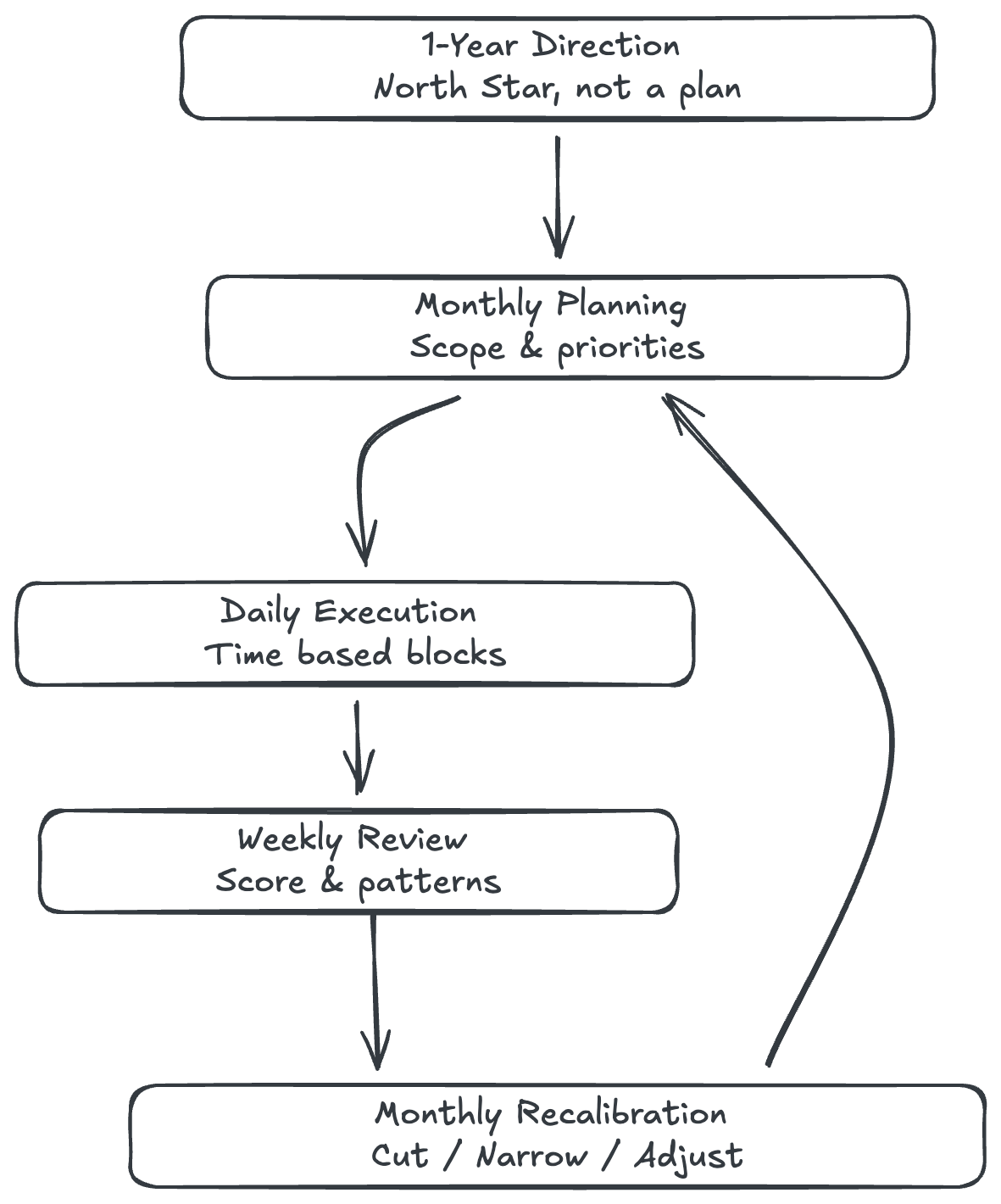
Direction stays stable. Execution stays small. Feedback is frequent. Change is intentional.
Daily Execution Is Time Based, Not Emotional
Execution happens in fixed time blocks.
Not because I feel like it.
Not because I’m inspired.
But because the block exists.
This matters because motivation is unreliable. Structure isn’t.
Some days I execute fully.
Some days I barely scrape through.
Both days count.
Energy Is Not Constant, So the System Can’t Be Fragile
One of the biggest realizations in the last three weeks was this:
Energy comes in phases.
Any long term plan moves through:
High energy (happy) phases
Low energy (unhappy) phases
Mixed, messy middle phases
Most systems are designed only for happy days.
That’s why they collapse.
I started thinking in simple paths:
Happy path: full execution feels easy
Unhappy path: bare minimum, protect the streak
Mixed path: partial execution, no guilt
The rule is brutal and simple:
Showing up beats doing it perfectly.
Life doesn’t care about my plans.
So my system had to work even on bad days.
On low energy days, I don’t renegotiate my life.
I shrink the effort, not abandon the system.
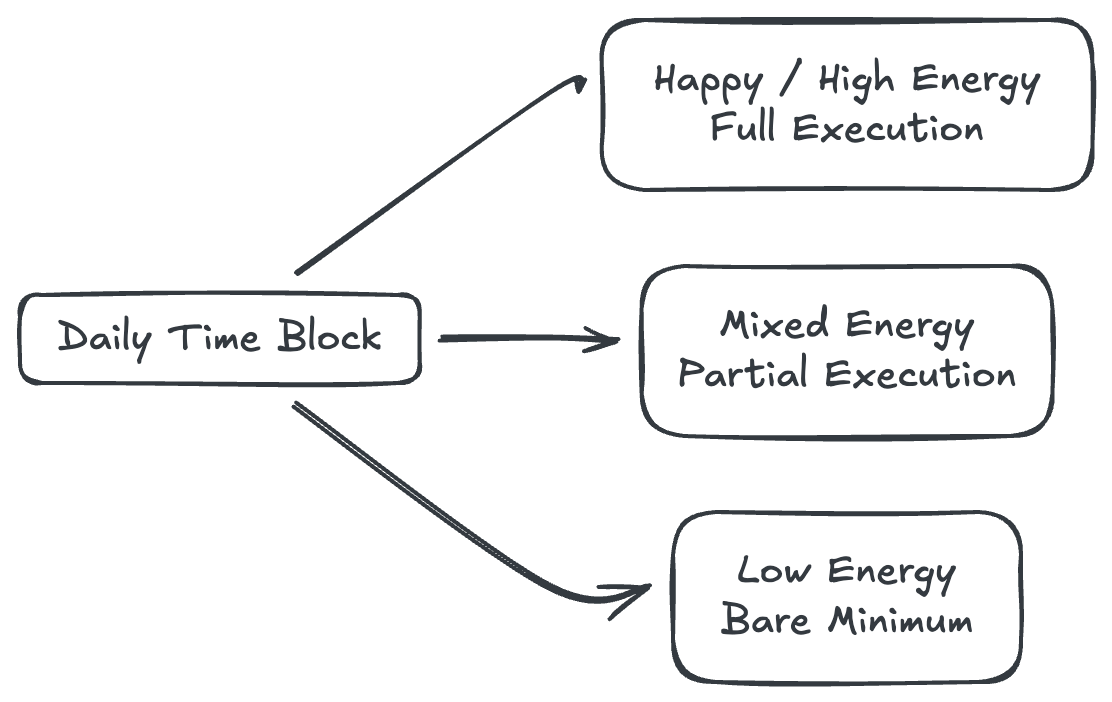
The block never disappears. Only the expectation changes.
Weekly Scores and Monthly Recalibration
Every week, I give myself a score.
Not based on feelings.
Based on behavior.
Did I show up to the blocks?
Where did I break the system?
What pattern caused it?
A low score doesn’t trigger self hate.
It triggers investigation.
Monthly, I recalibrate:
Drop what’s unrealistic
Narrow what’s bloated
Postpone without guilt
This is the part most people avoid, because it forces honesty.
Why I Don’t Wait for The Right Time Anymore
I stopped waiting for the perfect day to start.
Start today, and when that perfect day finally comes, you’ll already be far ahead.
I picked this up from Kunal Kapoor during an event:
Opportunity looks like luck only when preparation is invisible.
Life throws opportunities anyway.
Most people just aren’t ready when they arrive.
So the rule now is simple:
Don’t waste time. Do the work.
This Isn’t New, It’s Finally Internalized
I’ve tried versions of this before.
The difference now is internalization.
It’s not a productivity experiment anymore.
It’s habit formation.
Cue → Action → Reward.
Repeat. (I picked it from Atomic Habits).
Will it work perfectly forever? Probably not.
But what’s the harm in doing something pragmatic instead of endlessly planning?
There Is No Finish Line
There’s no winner spot.
There’s only one real question:
Am I better than I was a year ago?
Did I accomplish most of what mattered?
Am I moving in the right direction?
That’s it.
If the answer keeps improving year after year, the system is working.
And if someone still wants to wait for January 1 after reading this, that’s not ignorance anymore.
That’s a choice.